ENQUIRE NOW

Where is the best place to see the Northern Lights?

It sounds like a simple question, but there isn’t one location that wins every time. The Northern Lights are a natural phenomenon, so even the most famous Aurora destinations need the right combination of activity in the sky, darkness and clear weather.

What you can do is choose somewhere that puts the odds more firmly in your favour.

The best Northern Lights locations tend to have several things in common: they sit beneath or close to the Auroral Oval, offer easy access to dark skies away from artificial light and give you enough time and flexibility to take advantage when conditions are right.

So rather than looking for one magical postcode, here’s what really matters – and some of the places we think do it particularly well.


What makes somewhere a great place to see the Northern Lights?

1 – Location beneath the Auroral Oval

The Auroral Oval is the ring around the Earth’s magnetic poles where Aurora activity is most frequently seen. Much of northern Finland, Sweden and Norway lies beneath this zone, making these regions particularly well positioned for Northern Lights holidays. Iceland also sits far enough north to offer excellent Aurora opportunities when conditions are favourable. Being further north isn’t automatically better, though. Once you are within good Aurora territory, other factors become just as important.

2 – Dark skies

The Northern Lights can appear surprisingly bright, but weaker displays are much easier to see away from artificial light. That is one reason remote Arctic locations can be so effective. Wilderness hotels, small villages and countryside accommodation can often give you access to genuinely dark skies without having to travel far at all. It doesn’t mean cities are useless. Places such as Tromsø and Reykjavík can make excellent bases, provided you can travel away from the brighter urban areas when it is time to go Aurora hunting.

3 – Clear weather

You can have fantastic Aurora activity directly above you and see absolutely nothing if there is a thick layer of cloud in the way. That makes local weather conditions – and the ability to respond to them – hugely important. Most Northern Lights hunts are mobile for precisely this reason. Experienced guides can use local forecasts and their knowledge of the area to look for clearer skies rather than simply waiting in one fixed location.

4 – More than one night

One of the biggest advantages you can give yourself is simply time. A single cloudy evening can ruin a one-night Aurora hunt. Spend several nights in good Northern Lights territory and you have several opportunities for the conditions to come together. That is why we generally prefer Northern Lights holidays where the Aurora forms part of the whole experience rather than being something squeezed into one evening.

Wilderness Hotel Nangu

Finnish Lapland

For an all-round Northern Lights holiday, Finnish Lapland is very difficult to beat.

Head far enough north and you find vast areas of forest and wilderness with very little artificial light, alongside accommodation and activities specifically designed around the Arctic environment.

Locations including Saariselkä, Menesjärvi, Nellim and Muotka allow you to spend several nights deep in Northern Lights territory, while dedicated Aurora hunts can take you further into the wilderness when conditions are promising.

Finland also has one of the widest selections of glass-roofed cabins and Aurora accommodation, so your Northern Lights search doesn’t necessarily end when you return to your room.

It is particularly good for travellers who want to combine the Aurora with husky sledding, snowmobiling, snowshoeing and other classic Lapland experiences.

All Finland Holidays
Aurora Borealis above the ICEHOTEL in Swedish Lapland

Abisko and Swedish Lapland

Northern Sweden offers huge expanses of wilderness, low levels of artificial light and some wonderfully remote places to stay.

Abisko is one of the Arctic’s best-known Northern Lights locations. Its geography and local weather patterns have helped it build an international reputation among Aurora watchers, while the surrounding landscapes provide the dark skies you want once night falls.

Elsewhere in Swedish Lapland, destinations around Kiruna and Harads combine Aurora opportunities with Arctic activities and some very distinctive accommodation — including the world-famous ICEHOTEL®, Treehotel and Arctic Bath.

Sweden is particularly appealing if you want the experience to feel quieter, spacious and genuinely remote.

Image credit: Asaf Kliger and ICEHOTEL

All Sweden Holidays
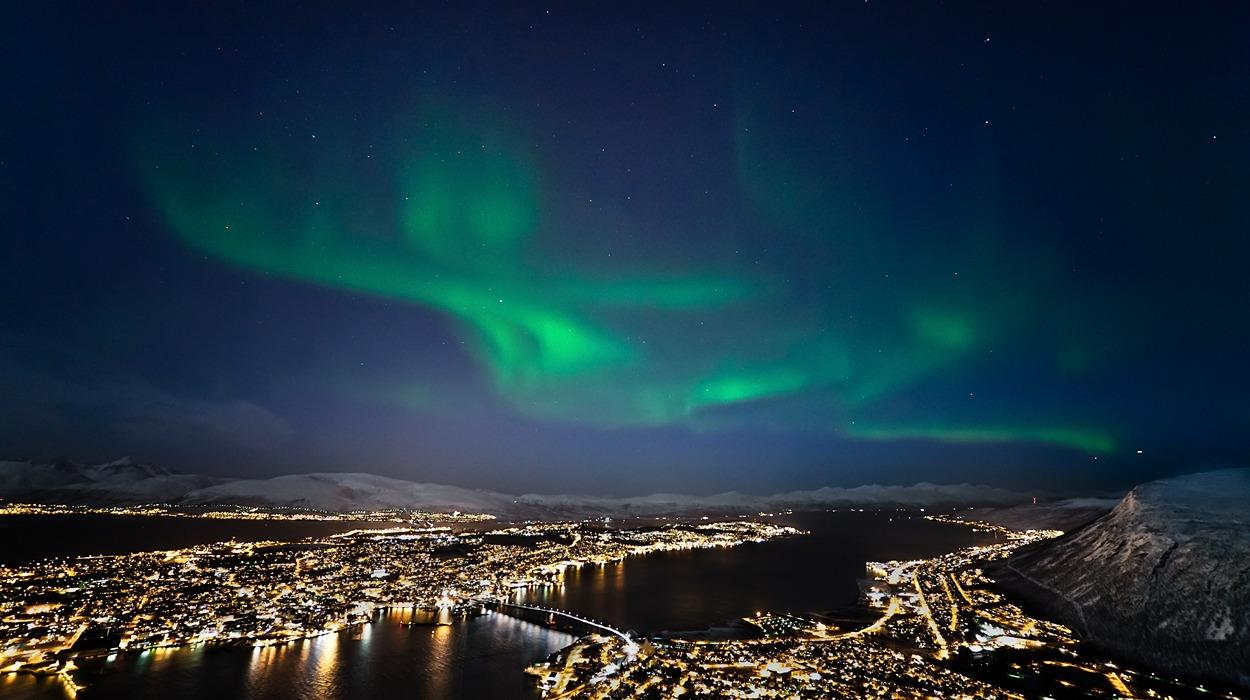
Aurora Borealis reflected in a Norwegian fjord

Tromsø and Northern Norway

Northern Norway combines excellent Aurora territory with some of the most dramatic landscapes in Scandinavia.

Tromsø has become one of the best-known bases for Northern Lights travellers. The city itself has artificial light, but its real strength is the enormous area surrounding it.

Mobile Aurora hunts can travel away from the city and, where appropriate, search across different areas for clearer conditions.

Beyond Tromsø, places such as Senja, Narvik and Svalbard offer mountains, fjords, islands and darker surroundings, making Norway particularly appealing if spectacular scenery is just as important to you as what happens overhead.

Image credit: Olec Salomonsen

All Norway Holidays

Iceland

Iceland offers a rather different way to search for the Northern Lights.

The Aurora can be combined with glaciers, volcanoes, waterfalls, geothermal landscapes and spectacular driving routes, which makes Iceland especially good for travellers who want the Northern Lights to be part of a broader adventure.

You will generally want to move away from Reykjavík’s artificial light for the best viewing conditions. Staying in the countryside or travelling independently also gives you greater freedom to explore when the skies are looking promising.

That independence can make Iceland particularly appealing to self-drive travellers, couples and families with older children or teenagers who want plenty to see and do during the daylight hours too.

All Iceland Holidays

Which Northern Lights destination should I choose?

This is where the answer becomes personal.

If your priority is snowy wilderness, glass-roofed accommodation and a huge choice of Arctic activities, Finland is an excellent starting point.

If you want mountains, fjords and the ability to chase clearer skies across a dramatic coastal landscape, look towards Northern Norway.

If remote wilderness, Abisko and distinctive accommodation such as the ICEHOTEL® appeal most, Sweden could be your answer.

And if you want independent exploration, natural wonders and the freedom of a self-drive adventure, Iceland has a very different appeal.

Want to compare them properly? Read our guide to where to see the Northern Lights in Finland, Norway, Sweden and Iceland.

Is there anywhere you are guaranteed to see the Northern Lights?

No – and we would be very suspicious of anybody who told you otherwise.

The Northern Lights depend on natural conditions. Solar activity, cloud cover, darkness and local weather can all affect what you see on any particular evening.

Choosing a good location cannot guarantee a display, but it can give you more opportunities. That means travelling within strong Aurora territory, spending several nights there, finding dark skies and making intelligent decisions based on the conditions.

This is also where specialist local knowledge can make a real difference. Our Northern Lights Hunting Formula explains how we approach the search.

When is the best time to see the Northern Lights?

The Northern Lights occur throughout the year, but you need darkness to see them.

Across the destinations we feature, the practical Northern Lights season generally runs from late summer or early autumn through to early spring, with the exact experience changing considerably across those months.

Autumn can bring milder conditions and reflections on unfrozen lakes, while deep winter provides the snowy landscapes many people associate with Lapland. Towards spring, longer daylight hours mean more time for daytime activities while the nights remain dark enough for Aurora hunting.

There is therefore no single “best month” for everybody.

Read our guide to the best time to see the Northern Lights for a more detailed look at the season.

Can you see the Northern Lights from a city?

Yes… but only during very strong displays; the artificial light makes weaker Aurora much harder to see.

Northern cities such as Tromsø and Reykjavík therefore work best as bases from which you can travel into darker surroundings.

Learn More About Northern Ligthts

Where Is The Best Place To See The Northern Lights?

When is the best time to see the Northern Lights?

Why are the Northern Lights sometimes coloured differently?

How likely am I to see the Northern Lights?

The Aurora Oval & the Ovation Map

What is the Solar Maximum?

How do the Northern Lights appear?

Does a full moon ruin your chances of seeing the Aurora Borealis?

Aurora Zone

Aurora Specialist

Exceptional Local Knowledge & Advice Every Step of The Way

Specialist

  • Aurora knowledge and experience
  • Unique holidays, in the very best destinations
  • Expert guides – exceptional local knowledge
  • Advice and guidance every step of the way

Comprehensive

  • We include more in our holidays than any other Aurora operator
  • Price Comparison guarantee
  • No hidden extras

Independent

  • Proudly Independent
  • The original and still the only dedicated UK Northern Lights tour operator
  • Personal, hands-on service
  • Fair and sustainable work ethos

Trusted

  • ATOL and ABTA protection available
  • Over 20 years’ experience
  • Our customers rate us 4.9/5 stars
  • Award-Winning: Best Travel Company to Northern Europe 2023
LOADING
Aurora Zone
0
Your Wishlist
Trip Enquire
Menu